

Foreword
Nigeria’s legal and regulatory landscape continued to evolve rapidly across 2025 and into 2026. Major developments included the commencement of the 2025 tax-law reforms, implementation of the CBN banking recapitalization programmed, continued development of the Arbitration and Mediation Act 2023 framework, expanding data protection enforcement, and the decentralization of intra-state electricity market regulation under the Electricity Act 2023.
This report brings together, practice area by practice area, developments that are relevant to our clients, including the 2025 petroleum licensing round and the approved 2026 licensing round, the 2025 Tax Acts and their 2026 implementation, the CBN recapitalisation programme, the Arbitration and Mediation Act 2023, public procurement and PPP reforms, state electricity-market transitions, and data protection and intellectual property developments.
At Summit Legal, our objective remains constant: to translate this fast-moving regulatory environment into clear, commercially useful guidance for the businesses, investors and institutions we serve. We hope you find this review a useful reference as you plan for the year ahead, and we welcome the opportunity to discuss how any of these developments may affect your business. The practice area chapters have been expanded to provide a fuller annual-review and forward-look treatment, following a thematic professional-report structure with market developments, regulatory developments, commercial implications and outlook.
Sadiq Aijya Idriss, PhD
Managing Partner
Summit Legal
OIL & GAS LAW
Licensing momentum, the 2025 round and the drive to 2 million bpd
Nigeria’s upstream petroleum sector entered 2026 with significant licensing and regulatory activity under the Petroleum Industry Act (PIA) 2021. The 2025 licensing round progressed to a commercial bid conference in July 2026, while NUPRC also confirmed that a further licensing round had received ministerial approval and was expected to commence by Q3 2026.
At Summit Legal, we track these developments closely because they shape the transactional and regulatory work our upstream, midstream and downstream clients bring to us from license applications and farm-outs to host community compliance and contracting reform.
The 2025 Licensing Round And The Road To 2026
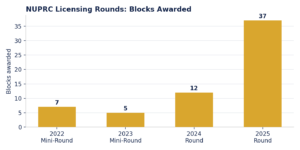
On 21 July 2026, the Nigerian Upstream Petroleum Regulatory Commission (NUPRC) announced that 31 companies had emerged as winners of 37 oil and gas blocks in the 2025 Licensing Round. NUPRC stated that 143 companies submitted 200 bids for 37 of the 50 blocks originally offered. The Commission clarified that the successful bidders would only receive final awards after payment of the applicable signature bonus and approval by the Minister of Petroleum Resources.
NUPRC announced in June 2026 that the 2026 Licensing Round had received the approval of the Minister of Petroleum Resources and would commence no later than the third quarter of 2026. At the time of the announcement, the Commission was finalising the launch; the specific timetable, acreage and bid terms should therefore be confirmed from the published 2026 round documents rather than assumed from the 2025 round.
Drill Or Drop And Contracting Reform
A defining feature of the PIA-era licensing regime is the enforcement of minimum work obligations and the Commission’s authority to take action against dormant or non-performing acreage. NUPRC has publicly linked its enforcement approach to the PIA’s “drill or drop” provisions and has urged successful bidders to develop awarded assets or risk losing them.
Separately, the Presidential Directive on Reduction of Petroleum Sector Contracting Costs and Timelines (the RCCT Directive) has introduced measures intended to reduce approval delays and streamline upstream contracting. Specific approval thresholds, approval routes and contract-duration rules should be applied by reference to the operative directive and NUPRC/NNPCL implementation guidance applicable to the transaction.
Gas Commercialisation And The Domestic Market
Nigeria’s official 2P associated and non-associated gas reserves stood at 215.19 trillion cubic feet as at 1 January 2026, according to NUPRC. Gas development and commercialisation remain important regulatory and investment issues, but current production figures vary by reporting period and source and should not be stated as a fixed daily figure without a date and source.
2025 Highlights
The 2025–2026 period has been characterised by a shift from broad policy reform to implementation. The Petroleum Industry Act (PIA) framework is now being tested through licensing, asset transactions, field development obligations, host-community structures, contracting approvals and the continuing evolution of gas and downstream markets. For investors, the legal question is no longer simply whether an activity is permitted, but whether the proposed structure can obtain the required approvals within the applicable regulatory sequence and remain commercially workable throughout the life of the project.
Upstream Market Dynamics
The completion of the 2025 licensing round is significant because it demonstrates that the PIA licensing architecture can be used to bring both established and frontier acreage to market. NUPRC reported that 143 companies submitted 200 bids for 37 of the 50 blocks offered, with 31 companies emerging as successful bidders for 37 blocks. Final awards remain conditional on payment of the applicable signature bonus and ministerial approval. The 2026 round creates a further pipeline of opportunities, but bidders should approach acreage acquisition as a development obligation rather than a purely speculative investment.
Asset Transactions, Farm-Ins And Farm-Outs
The continued participation of indigenous companies in upstream transactions is likely to keep mergers, acquisitions, farm-ins, farm-outs and portfolio restructurings at the centre of petroleum legal work. A purchaser of producing or brownfield assets must evaluate title, licence status, joint operating arrangements, decommissioning and abandonment exposure, environmental liabilities, outstanding regulatory obligations, employee and contractor claims, host-community arrangements and historical tax positions. The legal work should therefore begin with a transaction-specific regulatory and technical due-diligence plan rather than a conventional corporate due-diligence checklist alone.
Gas Commercialisation And Midstream Development
Gas remains a major commercialisation opportunity, particularly where projects can connect upstream reserves with power generation, industrial users, LNG, LPG, CNG, processing and transportation infrastructure. NUPRC’s 1 January 2026 reserves position reported 215.19 trillion cubic feet of official 2P associated and non-associated gas reserves. For developers, however, reserves are only one part of project bankability. Gas sales agreements, transportation arrangements, processing capacity, pricing, domestic supply obligations, credit support, take-or-pay provisions and regulatory approvals must be aligned before financial close.
Regulatory Developments And Local Content
The implementation of petroleum-sector contracting reforms and Nigerian-content requirements continues to affect procurement strategy, contracting timetables and project economics. Clients should map NUPRC, NMDPRA and NCDMB approvals at the planning stage and identify which consents are conditions precedent to execution, mobilisation or payment. Local-content planning should also be integrated into procurement documents, subcontracting arrangements, technical specifications and financing assumptions rather than treated as a post-award compliance exercise.
Forward Look: 2026–2027
The immediate legal priorities are likely to include the conclusion of the 2025 licensing awards, the 2026 licensing round, acreage development obligations, upstream asset transactions, gas infrastructure, host-community compliance and regulatory approvals. Clients entering the sector should undertake an early regulatory-perimeter assessment, maintain a licence and consent matrix, document ownership and technical capacity clearly, and build regulatory timelines into transaction completion schedules. For existing operators, compliance audits should be tied to actual field obligations, contracting practices and decommissioning exposure.
Blocks awarded across successive PIA-era licensing rounds, 2022–2025.
| WHAT THIS MEANS FOR CLIENTS
|
- NUPRC, “Meren Energy Promises Fresh Investments as NUPRC Commences 2026 Licensing Round Q3” (3 June 2026).
- NUPRC, “Winners of NUPRC’s 2025 Licensing Round Emerge” (21 July 2026).
- NUPRC, 2025 Licensing Round portal and official 2026-round announcement materials.
- NUPRC, official 2025 Licensing Round announcement and bid results.
- NUPRC, “Media Release on the National Annual Petroleum Reserves Position as at 1 January 2026.”
Our Services
- Upstream Oil & Gas
- Petroleum Exploration & Production
- Production Sharing Contracts
- Joint Ventures
- Farm-in/Farm-out Transactions
- Petroleum Contracts
- PIA Advisory
- NUPRC Regulatory Matters
- NMDPRA Regulatory Matters
- Petroleum Licensing & Approvals
- Petroleum Regulatory Compliance
- Host Community Matters
- Petroleum Taxation & Fiscal Matters
- Local Content
- Oil & Gas Acquisitions & Divestments
- Decommissioning & Abandonment
- Energy Disputes & Arbitration
- Government & Regulatory Interfaces
- Commercial Transactions in the Oil & Gas Sector

